

CryptoSpiel.com
No Result
View All Result
  • Home
  • Live Crypto Prices
  • Live ICO
  • Exchange
  • Crypto News
  • Bitcoin
  • Altcoins
  • Blockchain
  • Regulations
  • Trading
  • Scams
  • Home
  • Live Crypto Prices
  • Live ICO
  • Exchange
  • Crypto News
  • Bitcoin
  • Altcoins
  • Blockchain
  • Regulations
  • Trading
  • Scams
No Result
View All Result
CryptoSpiel.com
No Result
View All Result

How Bitcoin’s Use of Mathematical Tools Ensures System Consistency – Featured Bitcoin News

April 26, 2023
in Bitcoin
Reading Time: 5 mins read
A A
0
How Bitcoin’s Use of Mathematical Tools Ensures System Consistency – Featured Bitcoin News
0
SHARES
5
VIEWS
ShareShareShareShareShare

Over 14 years ago, Satoshi Nakamoto unveiled the Bitcoin network to the world, creating the very first triple-entry bookkeeping system known to mankind. This technological wonder, with a current market value of $540 billion, ingeniously integrates encryption and mathematical formulas to fortify its security. In this exploration, we delve into two of the mathematical choices that underpin Bitcoin’s complex architecture, determining block rewards, transaction inputs and outputs, and mining difficulty adjustments, while also regulating the pace at which new blocks are discovered.

Whole Numbers at Work: A Look at Bitcoin’s Use of Integers

Bitcoin was created using a variety of encryption processes and mathematical formulas, each with a specific purpose. One design element incorporated into Bitcoin is the use of integers, or whole numbers and their negative counterparts.

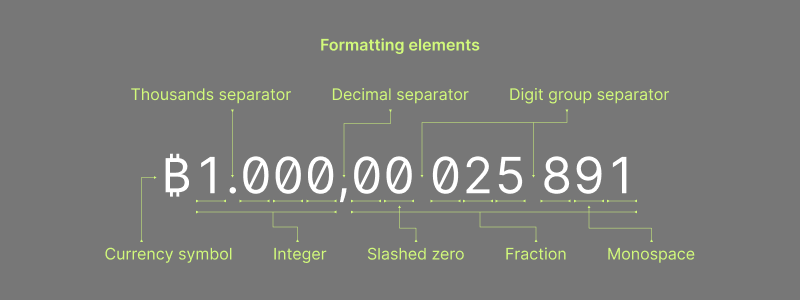
The Bitcoin network utilizes integer math to prevent potential disagreements that could arise if decimal or fractional numbers were used. The use of whole numbers and their negative counterparts ensures that all computational devices can synchronize more effectively and agree on specific network changes.
Satoshi's Math: How Bitcoin's Use of Mathematical Tools Ensures System Accuracy and Efficiency

The use of integers to maintain Bitcoin’s ruleset includes block rewards and halvings that occur at specific block heights divisible by 210,000. Bitcoin’s mining difficulty also utilizes integers to adjust the difficulty every 2,016 blocks. Integers, a type of numerical data frequently used in computational software, are also employed in Bitcoin transaction inputs and outputs.

Furthermore, integer calculations are generally faster and less prone to error than floating-point numbers. If Bitcoin were to use floating-point numbers, it could introduce rounding errors, leading to inconsistencies and disagreements between different nodes on the network.

Since Bitcoin uses integers, the block reward from a future halving will eventually be truncated or rounded down to the nearest whole number using bit-shift operators or a bitwise operation. Because the smallest unit of Bitcoin is a satoshi, it makes it impossible to halve. As a result, Bitcoin’s much-discussed capped supply of bitcoin will actually be less than 21 million.

Regulating Block Times with Poisson Distribution

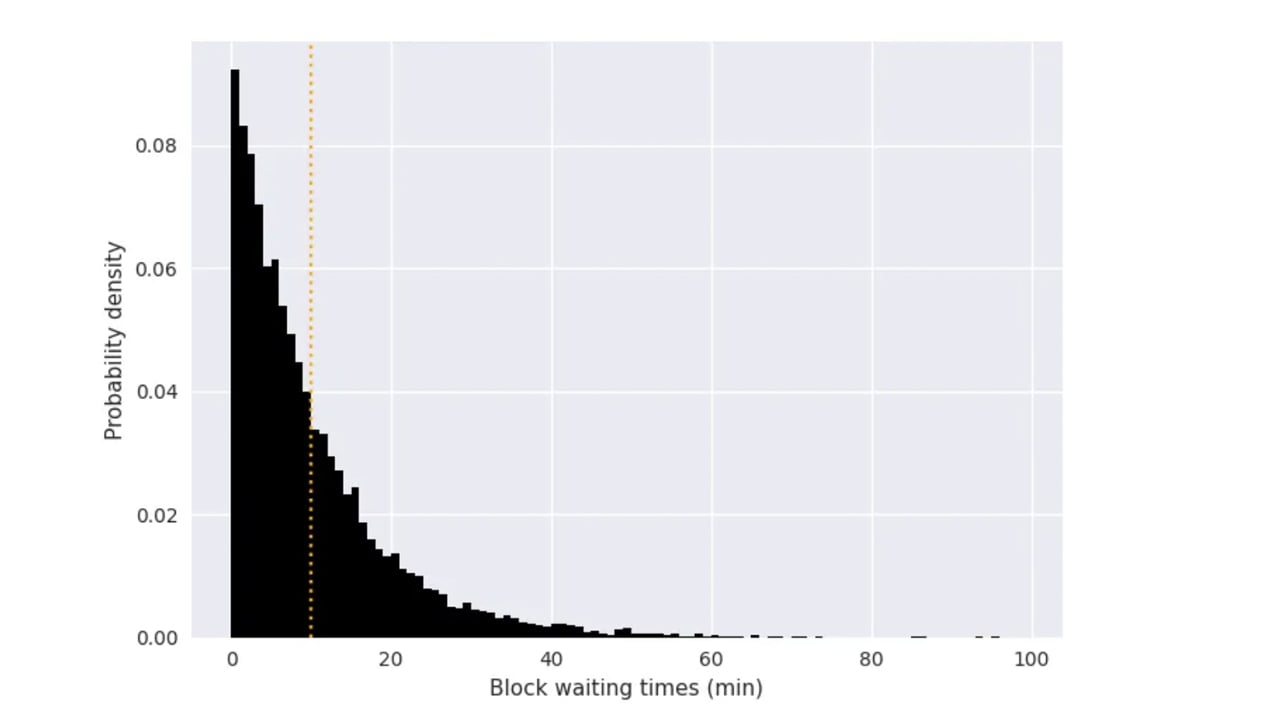
In addition to integers, Bitcoin employs a Poisson distribution-like mathematical formula to regulate block time consistency. The Poisson distribution model was developed in 1837 by French mathematician Simeon Denis Poisson. Using this model, Bitcoin’s design ensures that blocks are discovered every 10 minutes or so.
Satoshi's Math: How Bitcoin's Use of Mathematical Tools Ensures System Accuracy and Efficiency
In the May 2022 paper called “Explaining Bitcoin Mining as a Poisson Distribution,” author Suhail Saqan says “the orange line in the plot represents the mean waiting time (approx. 10 minutes). As we expected, the plot is shaped similar to an exponential distribution. The simulation of waiting times between bitcoin blocks approximates a poisson process.”

The actual time it takes to mine a block can vary due to the probabilistic nature of the mining process, but blocks are typically found within the range of 8 to 12 minutes. Satoshi incorporated a difficulty setting every 2,016 blocks using the formula to maintain the rough average of 10-minute block intervals.

Both integer math and Poisson distribution are essential mathematical tools in Bitcoin, providing a consistent framework for performing calculations and modeling various aspects of the system.

Bitcoin employs numerous other mathematical mechanisms and encryption schemes to ensure accuracy, consistency, and efficiency of the system as a whole. These include concepts and formulas such as proof-of-work (PoW), Merkle trees, elliptic curve cryptography, cryptographic hash functions, and finite fields, among others.

Tags in this story
accuracy, Bitcoin, consistency, efficiency, Elliptic Curve Cryptography, encryption, integers, mathematical, Mathematics, Merkle trees, Poisson distribution, Proof of Work, synchronization

What do you think about the mathematical schemes used by the Bitcoin network? Let us know your thoughts in the comments section below.

Jamie Redman

Jamie Redman is the News Lead at Bitcoin.com News and a financial tech journalist living in Florida. Redman has been an active member of the cryptocurrency community since 2011. He has a passion for Bitcoin, open-source code, and decentralized applications. Since September 2015, Redman has written more than 7,000 articles for Bitcoin.com News about the disruptive protocols emerging today.


Image Credits: Shutterstock, Pixabay, Wiki Commons, Chart by Suhail Saqan, Integer photo by Bitcoin Design

Disclaimer: This article is for informational purposes only. It is not a direct offer or solicitation of an offer to buy or sell, or a recommendation or endorsement of any products, services, or companies. Bitcoin.com does not provide investment, tax, legal, or accounting advice. Neither the company nor the author is responsible, directly or indirectly, for any damage or loss caused or alleged to be caused by or in connection with the use of or reliance on any content, goods or services mentioned in this article.

More Popular News

In Case You Missed It


Credit: Source link

RELATED POSTS

SEC Opens Proceedings on NYSE Proposal to List Grayscale Crypto ETF Options – Regulation Bitcoin News

Treasury Proposes Stablecoin AML Rules as Bessent Vows to Protect US Financial System – Crypto News Bitcoin News

Robinhood Charges Into Indonesia as Next Explosive Crypto Market

Buy JNews
ADVERTISEMENT
ShareTweetSendPinShare
Previous Post

CFTC Commissioner Calls for Reduced Cryptocurrency Anonymity

Next Post

Binance.US Pulls out of $1 Billion Asset Purchase Deal With Voyager

Related Posts

SEC Opens Proceedings on NYSE Proposal to List Grayscale Crypto ETF Options – Regulation Bitcoin News
Bitcoin

SEC Opens Proceedings on NYSE Proposal to List Grayscale Crypto ETF Options – Regulation Bitcoin News

April 11, 2026
Treasury Proposes Stablecoin AML Rules as Bessent Vows to Protect US Financial System – Crypto News Bitcoin News
Bitcoin

Treasury Proposes Stablecoin AML Rules as Bessent Vows to Protect US Financial System – Crypto News Bitcoin News

April 8, 2026
Robinhood Charges Into Indonesia as Next Explosive Crypto Market
Bitcoin

Robinhood Charges Into Indonesia as Next Explosive Crypto Market

December 9, 2025
Next Post
Binance.US Pulls out of $1 Billion Asset Purchase Deal With Voyager

Binance.US Pulls out of $1 Billion Asset Purchase Deal With Voyager

Crypto Has Evolved From Being Seen as an ‘Anti-Establishment Rebellion Asset’ Says FCA Executive Director – Regulation Bitcoin News

Crypto Has Evolved From Being Seen as an 'Anti-Establishment Rebellion Asset' Says FCA Executive Director – Regulation Bitcoin News

Recommended Stories

Bitcoin Addresses Holding Between 100 and 10,000 BTC Hit a 7-Week High

Anthropic Reveals Claude Code Tool Design Philosophy Behind AI Agent Development

April 10, 2026
Treasury Proposes Stablecoin AML Rules as Bessent Vows to Protect US Financial System – Crypto News Bitcoin News

Treasury Proposes Stablecoin AML Rules as Bessent Vows to Protect US Financial System – Crypto News Bitcoin News

April 8, 2026
SEC Opens Proceedings on NYSE Proposal to List Grayscale Crypto ETF Options – Regulation Bitcoin News

SEC Opens Proceedings on NYSE Proposal to List Grayscale Crypto ETF Options – Regulation Bitcoin News

April 11, 2026

Popular Stories

  • Winklevoss Twins Continue Crypto Donation Spree With Another $1,000,000 in Bitcoin (BTC)

    Trader Says DeFi Altcoin Aave Witnessing Clear Trend Switch, Updates Forecast on Two Low-Cap Coins

    0 shares
    Share 0 Tweet 0
  • Andreessen Horowitz Leads $160M Investment in Harvey at $8B Valuation

    0 shares
    Share 0 Tweet 0
  • China’s Guangdong Province Aims to Lead in Quality and Innovation by Embracing Blockchain and AI Technologies

    0 shares
    Share 0 Tweet 0
  • Best Meme Coins List Featuring Dogecoin, Shiba Inu, ApeMax, and Pepe Coin

    0 shares
    Share 0 Tweet 0
  • Commodity Strategist Mike McGlone Says Cryptocurrencies May Be Facing Their First Real Recession – Markets and Prices Bitcoin News

    0 shares
    Share 0 Tweet 0
CryptoSpiel.com

This is an online news portal that aims to provide the latest crypto news, blockchain, regulations and much more stuff like that around the world. Feel free to get in touch with us!

What’s New Here!

  • Ripple CEO Says CLARITY Act Talks Near Breakthrough as Senate Standoff Eases
  • SEC Opens Proceedings on NYSE Proposal to List Grayscale Crypto ETF Options – Regulation Bitcoin News
  • Anthropic Reveals Claude Code Tool Design Philosophy Behind AI Agent Development

Subscribe Now

Loading
  • Live Crypto Prices
  • Contact Us
  • Privacy Policy
  • Terms of Use
  • DMCA

© 2021 - cryptospiel.com - All rights reserved!

No Result
View All Result
  • Home
  • Live Crypto Prices
  • Live ICO
  • Exchange
  • Crypto News
  • Bitcoin
  • Altcoins
  • Blockchain
  • Regulations
  • Trading
  • Scams

© 2021 - cryptospiel.com - All rights reserved!

Please enter CoinGecko Free Api Key to get this plugin works.