

CryptoSpiel.com
No Result
View All Result
  • Home
  • Live Crypto Prices
  • Live ICO
  • Exchange
  • Crypto News
  • Bitcoin
  • Altcoins
  • Blockchain
  • Regulations
  • Trading
  • Scams
  • Home
  • Live Crypto Prices
  • Live ICO
  • Exchange
  • Crypto News
  • Bitcoin
  • Altcoins
  • Blockchain
  • Regulations
  • Trading
  • Scams
No Result
View All Result
CryptoSpiel.com
No Result
View All Result

NVIDIA’s VISTA-2D Model Revolutionizes Cell Imaging and Spatial Omics

July 25, 2024
in Blockchain
Reading Time: 3 mins read
A A
0
Nvidia Plans to add Innovation in the Metaverse with Software, Marketplace Deals
0
SHARES
10
VIEWS
ShareShareShareShareShare


Joerg Hiller
Jul 25, 2024 02:15

RELATED POSTS

Anthropic Reveals Claude Code Tool Design Philosophy Behind AI Agent Development

Riot Platforms Sells $289M in Bitcoin as Mining Output Drops 4% in Q1

Exploring Chainlink’s Role Beyond Price Feeds in the Blockchain Ecosystem

NVIDIA introduces VISTA-2D, a model enhancing cell segmentation and morphology clustering in spatial omics, offering a pivotal advancement for biological research.


NVIDIA has unveiled VISTA-2D, a foundational model designed to significantly improve cell segmentation in cell imaging and spatial omics workflows, according to NVIDIA Technical Blog. This model aims to enhance the accuracy of downstream tasks by leveraging advanced image embedding techniques.

Feature Extraction and Clustering

The VISTA-2D model employs an image encoder to generate embeddings that can be transformed into segmentation masks. These embeddings provide essential information about cell morphologies, allowing for precise cell segmentation. NVIDIA’s blog post explains that these embeddings can be clustered to group cells with similar morphologies automatically.

To demonstrate the model’s capabilities, NVIDIA has provided a detailed Jupyter notebook that walks users through the process of segmenting cells and extracting their spatial features using VISTA-2D. The notebook also shows how to cluster these features using RAPIDS, creating an automated pipeline for classifying cell types.

Buy JNews
ADVERTISEMENT

Prerequisites and Setup

Users interested in exploring the VISTA-2D model need a basic understanding of Python, Jupyter, and Docker. The Docker container required for this tutorial can be initiated with the following command:

docker run --rm -it \
    -v /path/to/this/repo/:/workspace \
    -p 8888:8888 \
    --gpus all \
    nvcr.io/nvidia/pytorch:24.03-py3 \
    /bin/bash

Additional Python packages needed for the tutorial can be installed using:

pip install -r requirements.txt

Cell Segmentation with VISTA-2D

The initial step involves loading a VISTA-2D model checkpoint and using it to segment cells in an image. The segmentation process generates a feature vector for each cell, which contains all necessary information for cell morphology analysis. These vectors are then used in clustering algorithms to group cells with similar features.

Segmenting Cells

The segmentation function processes the cell image through VISTA-2D, resulting in segmentation masks that label each cell individually. This allows for accurate feature extraction for each cell.

img_path="example_livecell_image.tif"
patch, segmentation, pred_mask = segment_cells(img_path, model_ckpt)

Plotting Segmentation

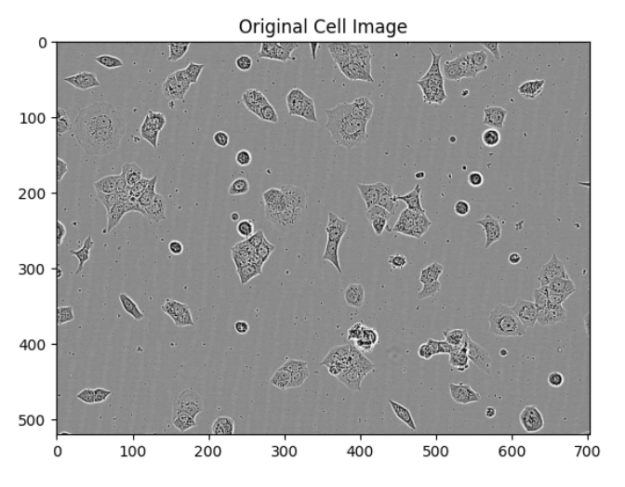
The segmented images can be visually verified using the plot_segmentation function. This function displays the original image, the segmentation result, and individual masks for each cell.

plot_segmentation(patch, segmentation, pred_mask)
original-cell-image-625x487.png
a) Original cell image
segmentations-625x480.png
b) Segmentations
individual-masks-625x485.png
c) Individual masks
Figure 2. VISTA-2D segmentation results

Clustering Features with RAPIDS

Once feature vectors are extracted, they are clustered using RAPIDS, a GPU-accelerated machine learning library. The TruncatedSVD algorithm reduces the dimensionality of the feature vectors, making it easier to visualize clusters in 3D space.

dim_red_model = TruncatedSVD(n_components=3)
X = dim_red_model.fit_transform(cell_features)

The DBSCAN algorithm is then used to cluster the reduced feature vectors. This method assigns cluster labels to each cell, which can be visualized using Plotly for an interactive 3D plot.

model = DBSCAN(eps=0.003, min_samples=2)
labels = model.fit_predict(X)
interactive-3d-diagram.png
Figure 3. Interactive 3D diagram that results from the plot of the clustered feature vectors

Conclusion

NVIDIA’s VISTA-2D model offers a significant advancement in cell imaging and spatial omics by providing accurate cell segmentation and feature extraction. Coupled with RAPIDS for clustering, this model enables efficient classification of cell types, paving the way for more detailed and automated biological research.

Image source: Shutterstock


Credit: Source link

ShareTweetSendPinShare
Previous Post

AI-Driven Molecular De-Extinction: A New Frontier in Combating Drug-Resistant Pathogens

Next Post

Gala Games Teases Upcoming ‘Mission Ready’ Premium Event

Related Posts

Bitcoin Addresses Holding Between 100 and 10,000 BTC Hit a 7-Week High
Blockchain

Anthropic Reveals Claude Code Tool Design Philosophy Behind AI Agent Development

April 10, 2026
Riot Blockchain Yearly Bitcoin Production Increases by 236%, Accumulates $194M in BTC
Blockchain

Riot Platforms Sells $289M in Bitcoin as Mining Output Drops 4% in Q1

April 2, 2026
Galaxy Digital: Ethereum Developers Discuss Key Upgrades During Latest Consensus Call
Blockchain

Exploring Chainlink’s Role Beyond Price Feeds in the Blockchain Ecosystem

December 9, 2025
Next Post
Gala Music Unveils NxWorries Mystery Box Featuring Exclusive Content

Gala Games Teases Upcoming 'Mission Ready' Premium Event

Riot Blockchain Yearly Bitcoin Production Increases by 236%, Accumulates $194M in BTC

Ontario Capital Markets Tribunal Terminates Bitfarms’ Poison Pill at Riot's Request

Recommended Stories

No Content Available

Popular Stories

  • Llama 3.1 Now Optimized for AMD Platforms from Data Center to AI PCs

    AMD Unveils LM Studio 0.3 AI Assistant with Enhanced Ryzen AI and Radeon GPU Integration

    0 shares
    Share 0 Tweet 0
  • Berkshire’s Charlie Munger Says ‘Ridiculous’ Anybody Would Buy Crypto — ‘It’s an Absolute Horror’ – Featured Bitcoin News

    0 shares
    Share 0 Tweet 0
  • Chinese Officials Tackle Rising Crypto Corruption, Call for Enhanced Legal Measures

    0 shares
    Share 0 Tweet 0
  • Paul Atkins confirmed to Chair SEC as Gary Gensler’s long-term replacement

    0 shares
    Share 0 Tweet 0
  • Jason Fang and the Rise of Bitcoin Adoption in Asia

    0 shares
    Share 0 Tweet 0
CryptoSpiel.com

This is an online news portal that aims to provide the latest crypto news, blockchain, regulations and much more stuff like that around the world. Feel free to get in touch with us!

What’s New Here!

  • Ripple CEO Says CLARITY Act Talks Near Breakthrough as Senate Standoff Eases
  • SEC Opens Proceedings on NYSE Proposal to List Grayscale Crypto ETF Options – Regulation Bitcoin News
  • Anthropic Reveals Claude Code Tool Design Philosophy Behind AI Agent Development

Subscribe Now

Loading
  • Live Crypto Prices
  • Contact Us
  • Privacy Policy
  • Terms of Use
  • DMCA

© 2021 - cryptospiel.com - All rights reserved!

No Result
View All Result
  • Home
  • Live Crypto Prices
  • Live ICO
  • Exchange
  • Crypto News
  • Bitcoin
  • Altcoins
  • Blockchain
  • Regulations
  • Trading
  • Scams

© 2021 - cryptospiel.com - All rights reserved!

Please enter CoinGecko Free Api Key to get this plugin works.