

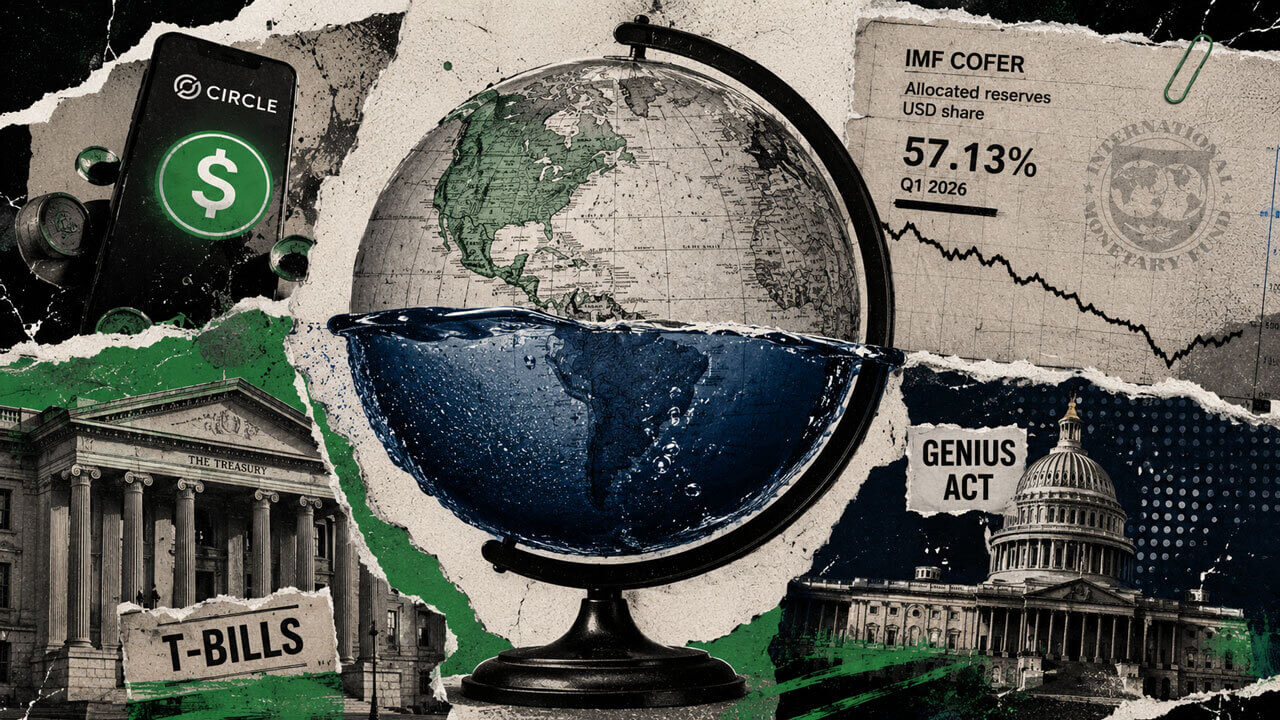
Circle president Heath Tarbert told Congress on Sept. 2 that placing digital-dollar infrastructure under US rules could reinforce the network effects that support the currency’s global role. The testimony framed stablecoin and digital asset legislation as a tool of dollar statecraft.
US rules can strengthen private dollar-token rails, while official reserve share remains a separate contest. Regulated stablecoins can spread private use of dollar-denominated tokens, change how issuers hold reserves, and add demand for short-term Treasuries.
Central banks remain responsible for deciding which currencies they hold. Tarbert acknowledged the boundary, arguing that payment technology cannot substitute for sound economic policy and that digital infrastructure cannot preserve dollar primacy on its own.
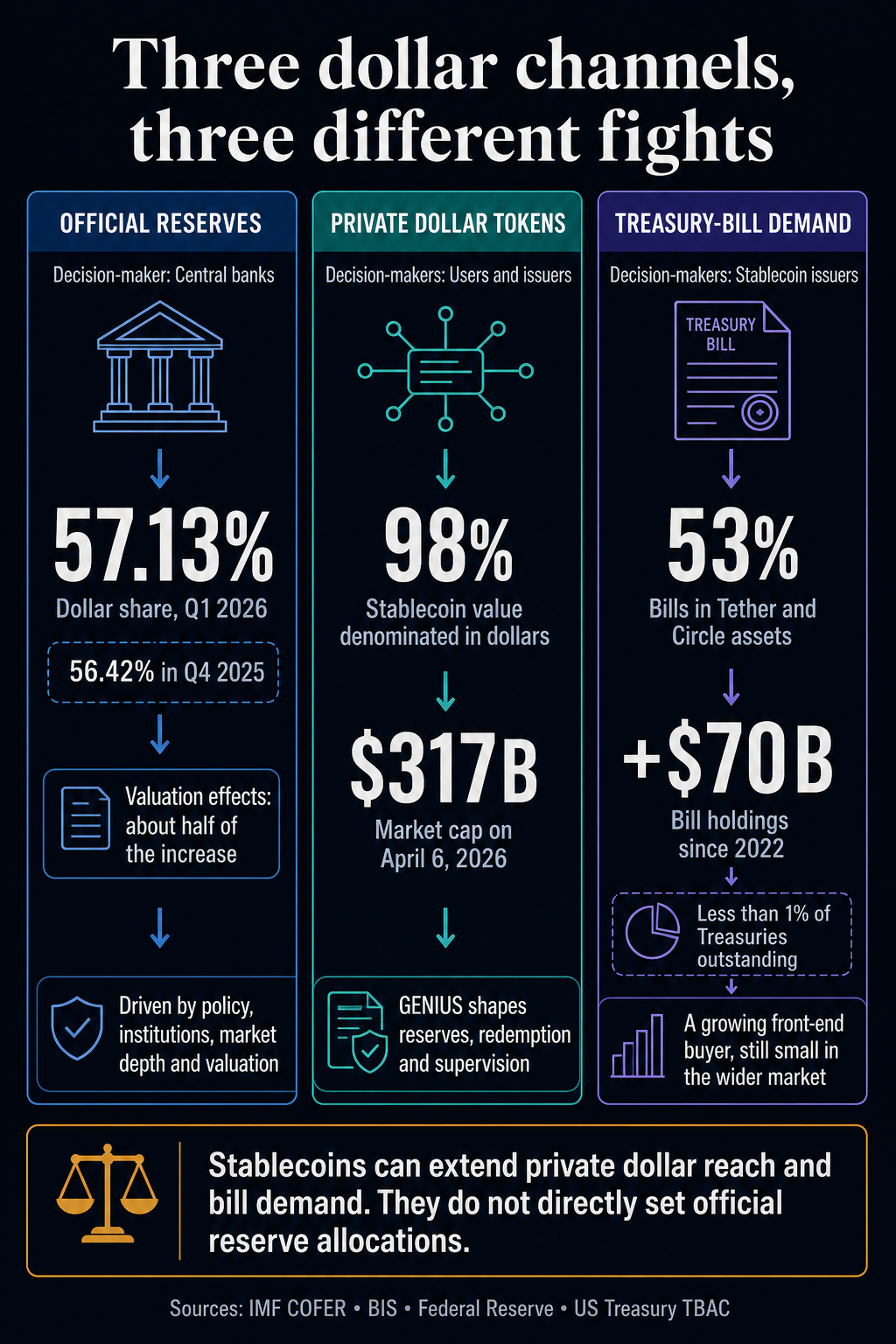
The dollar accounted for 57.13% of allocated global foreign exchange reserves in the first quarter of 2026, up from 56.42% in the fourth quarter of 2025, according to the International Monetary Fund’s latest COFER brief. Exchange-rate valuation effects accounted for around half of that quarterly increase.
The latest move was an increase, even against a longer-term decline in the dollar’s official reserve share. The valuation adjustment also prevents crediting the change to stablecoin adoption. A central bank’s reported reserve mix can shift when exchange rates move, even without an equivalent portfolio decision.
COFER tracks reserve assets reported by monetary authorities, and stablecoin market capitalization measures liabilities issued by private companies to token holders.
The Bank for International Settlements estimated that roughly 98% of stablecoin value is denominated in dollars. That shows the dollar’s dominance in private token markets.
BIS researchers nevertheless expect the near-term effects to appear mainly in private stores of value and means of payment, rather than in the official reserve, intervention or anchor-currency functions of central banks.
Stablecoins can consequently expand the dollar’s digital reach while fiscal credibility, institutions, market depth, and valuation forces continue to shape official reserve demand. This distinction separates consumers and businesses choosing a digital payment instrument from monetary authorities choosing a reserve portfolio.
What regulated stablecoins can change
The GENIUS Act issuer framework requires one-to-one permitted reserves, redemption at par, disclosures, supervision, and financial-crime compliance.
Those rules can improve reserve quality, influence where issuers locate, shape whether unlicensed issuers can offer stablecoins in the US, and steer more issuer assets toward short-term safe instruments.
GENIUS was enacted in July 2025, but its main requirements were not yet generally effective on the date of Tarbert’s testimony. Treasury’s August rulemaking notice said the general effective date was expected to be Jan. 18, 2027, unless final implementing rules made the law effective 120 days after their issuance.
A broader restriction on offering payment stablecoins from unlicensed issuers is scheduled to begin July 18, 2028.
Once it takes effect, the framework can govern backing, redemption, and supervision, leaving central bank currency allocations outside.
CLARITY addresses the trading and intermediary layer above stablecoins. The House passed the measure, the Senate Banking Committee advanced its portion 15-9, and the updated merged Senate text was released July 22.
The proposal’s principal function is to allocate jurisdiction between the Securities and Exchange Commission and the Commodity Futures Trading Commission and set rules for digital-asset intermediaries and markets.
If enacted, those rules could make US digital asset markets easier to operate in and extend the reach of regulated dollar tokens. Its effect would run through market structure rather than official reserve allocation.
Stablecoin issuers need liquid assets to support redemptions, and Treasury bills can satisfy that need. A Treasury Borrowing Advisory Committee analysis, using major-issuer data through September 2025, found that bills represented 53% of Tether and Circle assets. Their bill holdings had increased by $70 billion since 2022.
Even after that growth, stablecoin issuers held less than 1% of Treasuries outstanding. Their demand can affect the bill market at the margin, while broader demand for Treasury debt and official dollar reserves responds to other forces.
The Federal Reserve staff estimated stablecoin market capitalization at $317 billion on April 6, 2026, more than 50% above its level in early 2025. The date is essential because market capitalization moves continuously, and the figure should not be placed beside official reserves as if the series were equivalent.
The Fed analysis found USDC had high-quality reserves equal to its stablecoin liabilities. USDT reported total reserves at about 1.04 times liabilities, but higher-quality reserves at roughly 0.74 times liabilities.
Regulation can narrow those differences and make redemption promises more credible, a concrete way GENIUS could strengthen private dollar infrastructure.
Fed staff warned that complex intermediation, vertical integration and deeper links to traditional finance can increase opacity and contagion, amplifying operational or liquidity failures. Those dependencies can transmit problems further as adoption grows.
BIS researchers warn that broad adoption of dollar stablecoins could accelerate private currency substitution, weaken domestic monetary-policy traction and capital controls, and redirect emerging markets’ savings toward US Treasury bills. A run on a major issuer could then transmit stress into local financial systems and short-term dollar markets.
Migration from bank deposits toward stablecoins can also shift funding and intermediation outside familiar channels, even when issuer reserves ultimately flow back into government securities.
Tarbert’s case is strongest on these private rails. US rules can help determine whether dollar stablecoins grow within a supervised system, what backs them, and which markets they connect. Greater reach also enlarges the channels through which runs, operational failures and currency substitution can spread.
The IMF’s 57.13% figure records the separate decisions of official reserve managers, whose allocations respond to economic credibility, liquid market depth, institutions, policy, and valuation effects.
Stablecoins can extend the dollar’s private reach and create demand for its shortest-dated government debt. Official reserve share still turns on the policies that sustain confidence in the dollar itself.
Credit: Source link