
Key Takeaways
- Polymarket gives the CLARITY Act a 15% chance of 2026 enactment.
- Kalshi prices longer-term passage between 30% and 50%.
- A Senate cloture motion on the bill ripens at 2:15 p.m. Sept. 15.
Prediction Markets Remain Skeptical of 2026 Passage
Washington’s effort to establish national rules for crypto trading, custody, and market oversight now centers on the CLARITY Act. The House-passed bill would divide federal responsibilities between the Securities and Exchange Commission (SEC) and the Commodity Futures Trading Commission (CFTC) while setting requirements for exchanges, brokers, dealers, disclosures, and customer asset protection.
Prediction-market traders remain doubtful that the Digital Asset Market Clarity Act will complete the legislative process this year. A Polymarket contract on 2026 enactment showed a 15% chance on Sept. 2 that the CLARITY Act (H.R. 3633) would pass both chambers and receive the president’s signature by Dec. 31. Trading volume reached approximately $11.62 million.
The low probability contrasted with House Financial Services Committee Chairman French Hill’s renewed reference to the legislation during a Sept. 2 hearing on growth, affordability, innovation, and access to capital. In his prepared remarks, the Arkansas Republican listed House passage of the CLARITY Act among the committee’s accomplishments and called for permanent, predictable financial rules.
Kalshi’s longer-term contracts showed stronger probabilities, but they measure a broader outcome and cannot be compared directly with Polymarket’s 2026 contract. Kalshi gave the CLARITY Act, or another qualifying crypto market structure bill, a 30% chance of becoming law before July 1, 2027, and a 50% probability before Jan. 1, 2028. Volume totaled approximately $6.85 million.
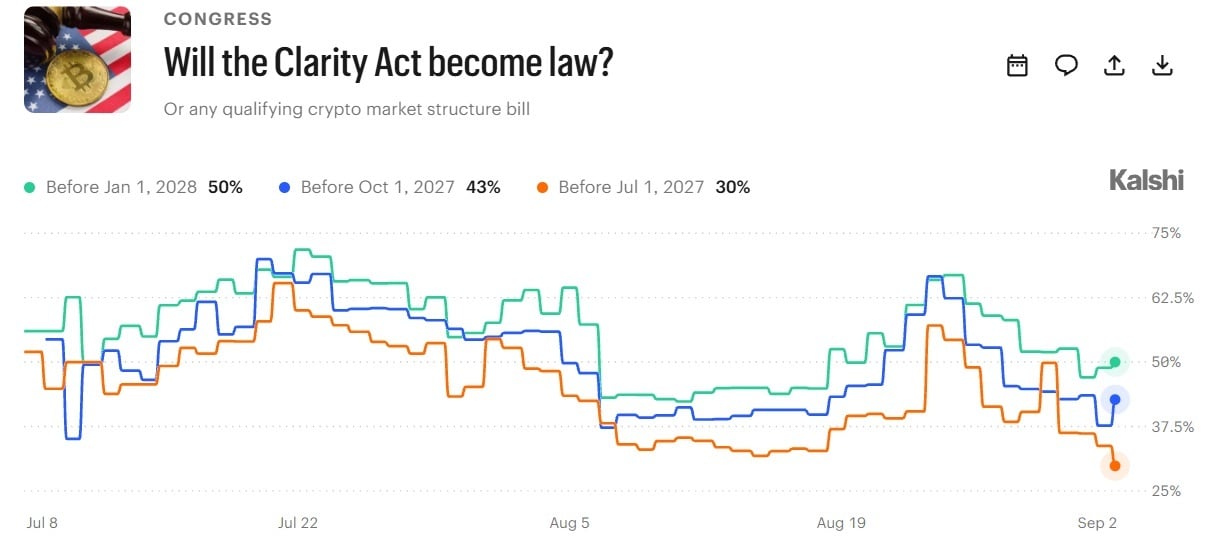
The latest figures show that traders distinguish between an imminent Senate vote and completed enactment. By Aug. 31, the market had already separated procedural progress from final passage, with traders assigning strong odds to a Senate vote but much weaker probabilities to the bill becoming law during 2026. Polymarket’s latest 15% reading rose from 13% but remained heavily weighted against enactment.
Sept. 15 Cloture Motion Becomes the Immediate Test
The next measurable step would be a procedural vote on the bill, which senators could hold as soon as Sept. 15. The official Senate schedule states that the cloture motion on proceeding to H.R. 3633 will ripen at 2:15 p.m. Cloture generally requires 60 votes, placing the bill’s future on its ability to retain bipartisan support.
The proposal has already demonstrated support across party lines at earlier stages. The Senate Banking Committee advanced H.R. 3633 by a 15-9 vote on May 14, moving it toward floor consideration. Democratic Senators Ruben Gallego and Angela Alsobrooks joined Republicans in supporting advancement, although committee approval did not establish sufficient support for cloture or final passage.
Senate negotiators subsequently released revised legislation combining work from the Banking and Agriculture committees. The updated CLARITY Act framework addresses SEC and CFTC jurisdiction, consumer protection, illicit finance, decentralized finance, intermediary oversight, disclosure requirements, and specified network tokens.
The revised language creates another timing consideration reflected in the low 2026 odds. Senate approval of provisions differing from the House-passed measure could require further action before the bill reaches the president. The Polymarket contract pays out only if H.R. 3633 completes every remaining step by the end of 2026.
Hill’s Regulatory Push Confronts the Legislative Clock
Hill placed CLARITY inside a wider economic program covering capital markets, housing, community financial institutions, and regulatory modernization. He stated: “Committee Republicans are working diligently to codify these reforms to make them permanent and predictable.” The prediction-market probabilities indicate that traders see the remaining congressional calendar as a significant obstacle to that objective.
The lawmaker did not deliver an extensive digital asset argument in the Sept. 2 statement, but he previously explained why he considers CLARITY essential. During a July field hearing marking one year since House passage, Hill compared stablecoin legislation without a crypto market framework to an incomplete communications system while the CLARITY Act remained unfinished in the Senate.
Hill stated:
“We need CLARITY in place because of a key point I always make: if you have GENIUS and dollar-backed stablecoin, which President Trump signed into law last July, but you do not have a market structure bill, you have passed authorization to have a cellphone but no cell network.”
The bill could affect centralized exchanges, decentralized platforms, brokers, dealers, token issuers, and customers. Centralized and decentralized cryptocurrency exchange structures raise different custody, compliance, and consumer-protection considerations that the proposed framework seeks to address.
If senators take up the cloture motion on Sept. 15, the vote would provide the next direct test of the market’s skepticism. Clearing the procedural threshold could improve expectations for Senate consideration, while failure would strengthen the 85% probability currently assigned to H.R. 3633 not becoming law during 2026.
Credit: Source link